
Research Campaign Highlights
FY2024 at the DIII-D National Fusion Facility
FY2024 Research Campaign Highlights
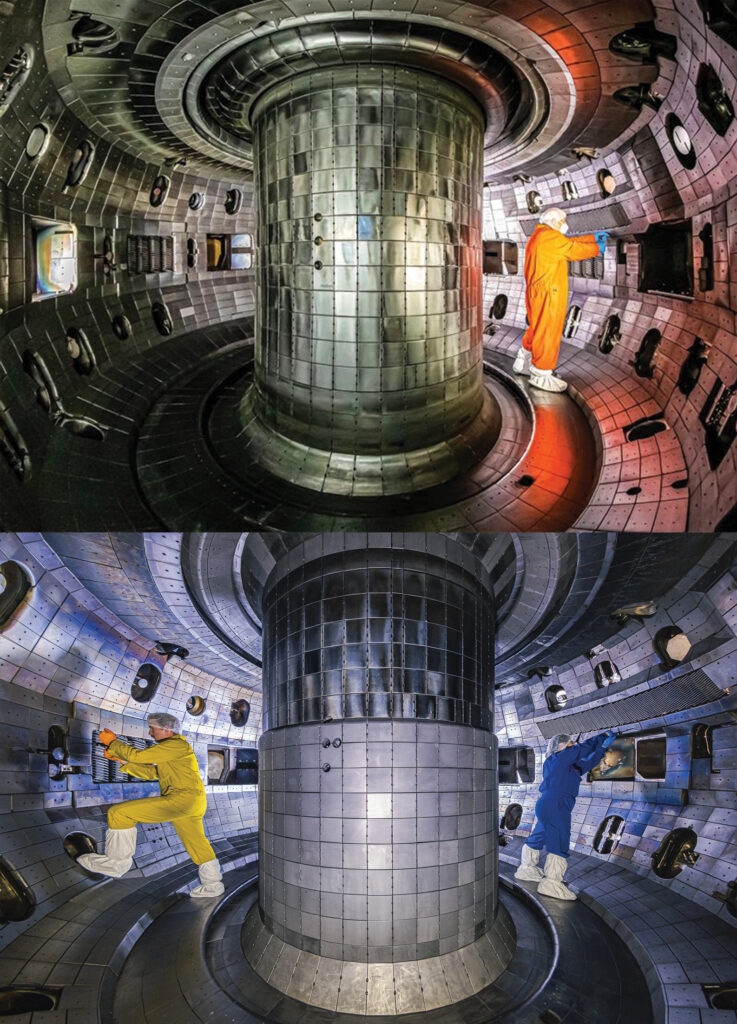
The FY2024 research campaign addressed priority plasma research questions related to viable commercial fusion designs. These topics included pioneering, testing, and refining key technologies and materials; investigating a new shape-and-volume rise divertor that allowed the team to explore the limits of high pedestal operation and access new reactor-relevant regimes; implementing and evaluating artificial intelligence and machine learning for plasma control; and completing priority studies to accelerate ITER’s path to Q=10 operation. The research begun during this year will continue into FY2025, enabling the team to achieve major advances through concentrated efforts in key research topics.
During the FY2024 campaign, experiments investigated a wide range of important fusion science and technology areas, ranging from foundational plasma physics studies to directly applicable testing of materials for use in fusion pilot plants. This 585-hr campaign comprised 53 experiments, including 13 experiments led by graduate students.
In August 2024, DIII-D completed its 200,000th plasma shot, a testament to the reliability of the tokamak and expert operation by the team, as well as the program’s continued commitment to evolve to meet the ever-changing priorities and key challenges in fusion science and technology.
Research Group Highlights
Below, the three 2024 Physics Groups are broken down by topical area. The subsections describe some of the major highlights for the listed topical areas and Research Task Forces during the FY2024 run campaign at DIII-D.
Fusion Pilot Plant Research
The FPP Research Group pursued priority research areas related to both pulsed and steady-state pilot plant designs, with emphasis on both foundational scientific work and initiatives with targeted application potential.
Steady State & Pulsed Fusion Core
- An experiment in the Steady-State and Pulsed Fusion Core (SSPFC) group developed a high-qmin scenario utilizing the shape and volume rise (SVR) divertor. Several plasmas were produced with stronger shaping, including higher elongation, upper and lower triangularity, and with the upper strike point coupled to the new SVR pump opening. Strike point sweeps were performed to optimize pumping in the SVR divertor while various fueling configurations were used to study access to small ELM regimes.
- A PhD award experiment in the SSPFC Area explored active tearing mode stabilization with real-time ECH steering. This experiment used a machine learning algorithm to predict the likelihood of a Fmode. When the likelihood reached a preset value, the control algorithm changed the aiming of the injected microwaves to either the q=2 or q=3 surface to suppress the tearing mode.
- An SSPFC experiment studied the shaping dependence of n=2 stability limits and their control in FPP-relevant plasmas. The n=2 plasma response was characterized at plasma pressures above the n=2 no wall limit and the n=2 error field correction was optimized in this regime. Attempts were made to increase proximity to the n=2 no-wall limit by decreasing the plasma internal inductance and applying high amplitude n=2 field ramps.
Plasma Controls
- DIII-D is equipped with magnetic coils that respond quickly to commands, are placed close to the plasma, and are numerous. Due to more intense constraints for future devices, most designs have fewer coils that are farther from the plasma with slower response times. This will make magnetic shape control more challenging than it is on DIII-D. To allow DIII-D to serve as a platform for testing control solutions for these future devices, the DIII-D plasma control system was equipped with an emulation package that can artificially slow and weaken magnetic coil responses and map commands to a reduced number of virtual coils onto nearby real coils. This emulation package was used to test control solutions designed with these constraints in mind.
- In addition to the above control research experiments, the plasma control area managed some control support experiments that tested and improved techniques that were used in other experiments. These covered preliminary developments related to the magnetic actuator emulation package, development of plasma conditions for consistently exposing material samples, development of plasma shaping for negative triangularity studies, support for collaborative research between DIII-D and KSTAR via development of a DIII-D plasma operating scenario similar to typical conditions in the KSTAR tokamak, and commissioning of a real-time variant of TORBEAM, which is a model for heating and current drive deposition within the plasma that supports finer control.
Core-Edge Integration
- An experiment was performed to examine a high-performance plasma scenario with a high-beta hybrid core, small ELMs and divertor detachment. This experiment explored access to a naturally occurring small ELM regime in the high-beta hybrid scenario for both low-collisionality and high-collisionality pedestal paths. A series of scans involving plasma current, fueling rate, q95, and total injected power was utilized to identify the operational space and investigate the pedestal and ELM physics. Attempts were made to assess divertor detachment integration by scanning divertor impurity seeding rate, aiming to find a viable core-edge integrated solution for high beta hybrid plasmas.
- Another experiment investigated access to the Enhanced Pedestal H-mode (EH) using injection of a low-Z impurity powder, including boron and lithium powders, alongside a newly developed adaptive RMP controller. Scans of impurity injection rates, q95, and neutral beam powers were performed to characterize and understand the physics of the impact of low-Z impurities on pedestal stability and transport.
Negative Triangularity
- A negative triangularity shape development control experiment was performed to demonstrate shape control utilizing an improved power supply and control setup; this was done to address challenges that arose during the 2023 campaign. Scans at higher plasma currents, X-point location, and faster shape control response times were performed to ascertain the achievable operating space of this negative triangularity shape.
- A PhD thesis experiment to understand the turbulence and transport physics of negative triangularity plasmas was conducted. Matched negative and positive triangularity plasmas were created, and then the average triangularity and beam power were varied to further understand the physics of the NT-edge and the transition to H-mode while collecting as much turbulence diagnostic data as possible.
- An experiment was performed to explore detachment in unfavorable drift configurations and obtain 2D divertor data for model validation to help design of a new negative triangularity divertor. Scans in plasma current, electron density, and impurity seeding were performed to characterize access to divertor detachment.
Divertor Science and Innovation
- The stability of the radiation front for divertor configurations with variable leg length was examined to guide the validation effort of the staged divertor project. Power injected and shaping of the divertor geometry were explored independently, with the goal of both understanding how well the radiation front can be held between the cold targets and hot plasma core, and, in an ‘open’ divertor configuration, acting as a critical comparison case to the future Stage 2 Divertor project, the dissipation-focused divertor, where neutral recycling is predicted to add a powerful cooling mechanism to the divertor plasma.
- A coordinated experiment performed by a team led by a DIII-D postdoc and an international scientist was completed to quantify plasma-molecular interaction effects on divertor detachment and simultaneously use those data for validation of complex, non-linear edge fluid codes. Employing the extensive array of spectroscopic, imaging, and other divertor diagnostics on DIII-D, this experiment helped inform how recycling neutrals source and transport in the plasma, and in particular, characterized the degree of detachment of the high-field side divertor.
- A novel experiment to probe the time dependence of dynamic gas puffs on DIII-D plasma was carried out with the goal of validating the SOLPS-ITER edge/boundary fluid code. Carried out with coordination between the physics and operations teams, this system identification and verification for the code is an important step toward being able to rely on the modeling results for transient circumstances occurring in plasma.
Thrust: Shape and Volume Rise
- A new divertor geometry that enables elevated plasma shape and volume was installed on DIII-D. A phased approach was taken to leverage physics from the new divertor to quantitatively characterize the pumping efficiency, develop three scenarios to target access to the Super H-mode channel (ELMy, QH-mode, and RMP ELM suppressed regimes), perform shape scans to validate the motivational EPED modeling, and leverage the state of high pressure at high density to study physics like detachment, impurity transport, and pellet fueling. The plasma control system was modified, and a new arrangement of the field shaping coil power supplies allowed both access and control for large plasma shapes up to 2.2MA.
- Experiments focused on ELMy H-mode scenarios developed two distinct trajectories towards Super H-mode channel access through a “hybrid approach” and a “classical approach”. The hybrid approach maximized pedestal temperature and minimized density in the L-mode before the LH transition. The classical approach biased the plasma towards the lower divertor in the L-mode phase at low power, then flipped to the new SVR divertor in the H-mode phase in the favorable grad-B direction. Plasma density, injected power, and the current ramp were tailored in the beginning of the discharge to optimize access to peeling instabilities in the pedestal region. Scans of triangularity and squareness were performed for EPED model validation.
- Experiments using resonant magnetic perturbations (RMP) to enable the suppression of a typically large first ELM during the trajectory into the Super H-mode plasma were performed. Triangularity scans were performed to assess the tradeoff between a robust high field side plasma response required for ELM suppression and access to the Super H-mode channel, which is typically optimized at high triangularity.
Plasma-Interacting Technology
The PIT Research Group, a newly established group in 2024, focused on expanding efforts to explore and optimize reactor-compatible techniques and materials. The group’s efforts were shaped by dialogue with the larger fusion community, including the commercial sector, to identify high-priority areas of interest. This work built upon existing DIII-D strengths, such as heating & current drive and disruption mitigation, while also moving into new areas of need, such as FPP diagnostics and innovative components.
Plasma-Material Interactions
- Erosion and re-deposition of tungsten were quantified during negative triangularity plasma discharges in DIII-D for the first time. By utilizing this unique plasma geometry, researchers accessed high densities near the plasma-facing surface that approximate reactor-relevant conditions. Spectroscopic measurements taken in the ultraviolet wavelength range during exposure and post-mortem surface analysis will enable the benchmarking of important atomic physics quantities used for future performance predictions.
Diagnostics and Actuators
- Work on pellet injection and pellet fueling continued under an Early Career Research Program award. Key progress included commissioning a new HFS microwave cavity for pellet mass measurements, installing a Pellet Sizer and demonstrating successful variation of pellet mass, and adding the capability to use PCS feedback control to adjust plasma density via pellet injection. A postdoctoral fellow was also onboarded to the project to support research efforts.
Heating and Current Drive
- A series of experiments were conducted with the helicon heating and current drive system to demonstrate power deposition with the Electron Cyclotron Emission (ECE) diagnostic and measure current drive with the Motional Stark Effect (MSE) diagnostic. Comparison shots with electron cyclotron heating and/or current drive were obtained. Experiments were performed in L-mode, standard H-mode, and high-beta H-mode.
- An experiment investigated the effect of using electron cyclotron (EC) heating in the burn-through phase during the early stages of plasma discharge. Different fill pressures and EC powers were explored, and results were compared to burn-through in the absence of EC assist.
Thrust: FPP Candidate Wall Materials
- A range of advanced plasma-facing materials (including dispersoid strengthened tungsten, tungsten heavy alloys, functionally graded and fiber W composites, and ultra-high temperature ceramics, among others) were tested under tokamak divertor conditions using the Divertor Material Evaluation System (DiMES). Fifty-two samples were exposed to high heat fluxes and OSP variations; post-mortem analysis is underway.
- Liquid lithium retention and transport in a heated (350°C) tungsten Capillary Porous Structure under H-mode plasma was evaluated. Lithium evaporation, impurity outgassing, and deuterium puffing effects were studied.
ITER Research
The ITER Research Group worked closely with the ITER International Organization to determine how DIII-D can best address the highest priority and nearest term ITER scientific concerns. The group met with Alberto Loarte, head of the ITER Science Division, to discuss which experiments are most urgent and translated those into high-priority goals, including measuring high-Z impurity transport from wall-to-core and performance of strongly electron-heated H-mode plasmas. Group members also worked closely with multiple ITPA topical areas to present the latest DIII-D research and learn about recent results from other tokamaks.
Transient Control
- An experiment was performed to understand differences in requirements for suppressing Edge Localized Modes (ELMs) by Resonant Magnetic Perturbations (RMPs) in dominantly ion– vs. Electron–heated plasmas. I-coil amplitudes were varied, along with q95 via slow Ip ramps, ECH/ECCD power and beam torque. These results will be used to test model-based methods of achieving RMP ELM suppression in ECH-dominated plasmas.
- An experiment utilized applied 3D fields to induce islands and scan the plasma drift frequency by changing the neutral beam injection and density. The analysis of this experiment will contribute to the identification of the optimum passively stable ITER baseline operation.
- Experiments optimizing the n=1 resonant magnetic perturbations (RMPs) in DIII-D for ELM control were performed. Predict-first modeling was utilized to optimize the relative amplitude and phases of the 3 RMP coil arrays, and the impact of these optimized configurations were measured in the experiment to be compared to the modeled predictions. This was a PhD thesis experiment.
- Experimental investigations of the origins on m/n > 2/1 tearing modes as well as their dependence on shaping and rotation were performed in DIII-D. The experiments controlled the plasma elongation using DIII-D’s flexible poloidal field coils and rotation using the different DIII-D neutral beam lines. The parameters resulting in tearing modes were recorded to inform our understanding of fundamental MHD stability limits. This was a PhD thesis experiment.
Pedestal and Non/Small ELM Regimes
- Small ELM physics was investigated, focusing on shaping and collisionality effects as well as integration with a high-beta hybrid core and divertor detachment.
- A fueling and particle transport experiment was initiated, leveraging the newly developed neutral diagnostics and DIII-D pedestal measurements to quantitatively investigate and compare the effects of neutral fueling and turbulent transport on the pedestal structure with a highly opaque edge.
Turbulence and Transport
- An experiment was performed to validate models for predicting the rotation profile in ITER and other low–rotation plasmas and better understand the relevant driving mechanisms behind intrinsic rotation. Regimes with low input neutral beam injection (NBI) torque and dominant electron cyclotron heating (ECH) were developed to access Trapped-Electron-Mode-dominated regimes to compare and contrast with more comprehensively explored ion temperature gradient-dominant regimes.
- A comprehensive analysis of isotopic differences controlling the L-H transition in hydrogen and deuterium plasmas, and the role of impurity dilution in transition physics, was produced. This work employed extensive gyrofluid and gyrokinetic turbulence simulations as well as advanced synthetic diagnostics to compare simulation results to experimental turbulence data and transport analysis. This work was part of a PhD thesis.
- The role of turbulence-driven Reynolds Stress in driving intrinsic edge rotation was examined. This is the first measurement of turbulent Reynolds stress and intrinsic torque in the plasma outer core. The main results of this work were presented in a plenary talk at the 2024 Transport Task Force (TTF) meeting and as an invited talk at the 2024 APS-DPP conference. This work was part of a PhD thesis.
ITER Integrated Scenarios
- An experiment was performed to investigate the impact of tungsten radiation on the ramp-up phase of the ITER baseline scenario. Krypton impurity injection was used to achieve tungsten-equivalent radiation at DIII-D’s electron temperature, which is lower than ITER’s. In addition, the use of electron cyclotron heating to enhance impurity transport and reduce radiation was investigated.
- An experiment was performed studying the dependance of runaway electron generation during plasma startup on the prefill pressure and plasma current ramp rate; tools to mitigate the generation, such as gas puffing and ECH pre-ionization, were also tested. The results will inform the ITER startup scenario design and support the development and benchmarking of models.
Thrust: High Opacity & Density Operation
- An experiment was performed to identify the underlying mechanisms that limit density in tokamak plasmas. Controlled density, plasma current and combined Ip/Bt ramps at fixed q95 were performed, while comprehensive profile, turbulence, and SOL measurements were obtained to test modern theoretical models predicting the density limit. The new STATIN and proximity controller with Real-Time Thomson measurements were also implemented. This was a PhD thesis experiment.
- An experiment was performed to characterize the role of scrape-off-layer (SOL) flows and divertor recycling in inducing in-out and up-down asymmetries in main chamber neutral fueling. Attached inner divertor conditions were achieved in both Bt directions. Beam torque was scanned to investigate its effects on SOL flows, fueling asymmetries and pedestal performance.
- A negative triangularity experiment aimed to test the power dependence of the density limit with different triangularity levels, disentangle the effects of shear flow from power input, and suppress slow MHD modes at high density. Beam torque, input power and RMP were varied at two top triangularity levels. Comprehensive profile, turbulence, and SOL measurements were obtained during the experiment to test physics models.
- An experiment was performed to quantitatively investigate and compare the effects of neutral fueling and turbulent transport on the pedestal structure in a highly opaque edge. It leveraged the newly developed neutral diagnostics and DIII-D pedestal measurements. Scans of gas puffing magnitude, edge magnetic shear and r* (normalized ion gyroradius, ri/a) on pedestal turbulence and pedestal were started.
Thrust: Fast Ions, Turbulence and Alfven Waves
- Several experiments that studied the relationship between Alfven eigenmode excitation and changes in microturbulence and axisymmetric plasma flows were performed. The work is related to the possibility that, in some reactor regimes, instabilities excited by charged fusion products may improve thermal plasma confinement.
Task Forces
Integrated High-𝛃p Scenarios
- The first joint DIII-D and KSTAR high poloidal beta experiment was carried out at DIII-D. The main goal was to establish a high poloidal beta scenario with large-radius ITB using KSTAR-like constraints, such as lower initial IP, slow dIP/dt, KSTAR reference shape, and delayed transition limited-diverted plasma. The experiment investigated the effects of electron cyclotron and beam injection on the qmin evolution and the impacts of plasma shape on plasma stability and confinement.
- A high poloidal beta experiment in an ITER-similar shape aimed to improve energy confinement compared to that achieved previously by increasing impurity exhaust while maintaining divertor detachment and ELM control. First, the plasma shape had to be adjusted to fit in the new SVR divertor. Then, different neon injection waveforms and injection locations were tested, together with different electron cyclotron injection configurations.
- A high poloidal beta experiment aimed to increase (relative to previous achievements) the duration of high performance operation at high betaN (~4), high Greenwald fraction (~1) and high non-inductive fraction (~90%), by using improved cross–section shaping (higher triangularity and smaller outer gap) and additional current drive sources, such as electron cyclotron current drive (ECCD). ECCD injection was carried out with dynamical poloidal steering, to keep the deposition at roughly the same off-axis location while plasma parameters (Bt, density) were changing during the shot. An optimization of the plasma shape and gas fueling waveforms resulted in significant extension of the high performance duration compared to the reference shot. Additionally, detachment studies were carried out in piggyback mode using nitrogen. Various amounts and waveforms of the impurity injection were tested.
Long-Pulse Tungsten-Compatible Steady-State Scenario
- A steady-state hybrid scenario was developed on DIII-D for transfer to KSTAR with a tungsten impurity environment, successfully adapted to superconducting operational constraints, tested for tungsten resiliency using W-LBOs, and established as a reference for long-pulse operation at KSTAR.
- Experiments investigated access to pedestal conditions dominated by neoclassical ion temperature (Ti) screening, which are expected to be present in ITER and fusion pilot plant (FPP) plasmas. The best conditions for the Ti screening were anticipated in steady-state hybrid discharges, which show a relatively flat electron density pedestal and steep temperature pedestal.