
Negative Triangularity at DIII-D
Winner of the 2026 John Dawson Award
DIII-D Team Wins Prestigious Plasma Physics Award for Demonstrating Viability of Negative Triangularity for Commercial Fusion
Multi-institutional team wins John Dawson Award for Excellence in Plasma Physics Research for pioneering work at the DIII-D National Fusion Facility advancing a unique operational approach for fusion devices.
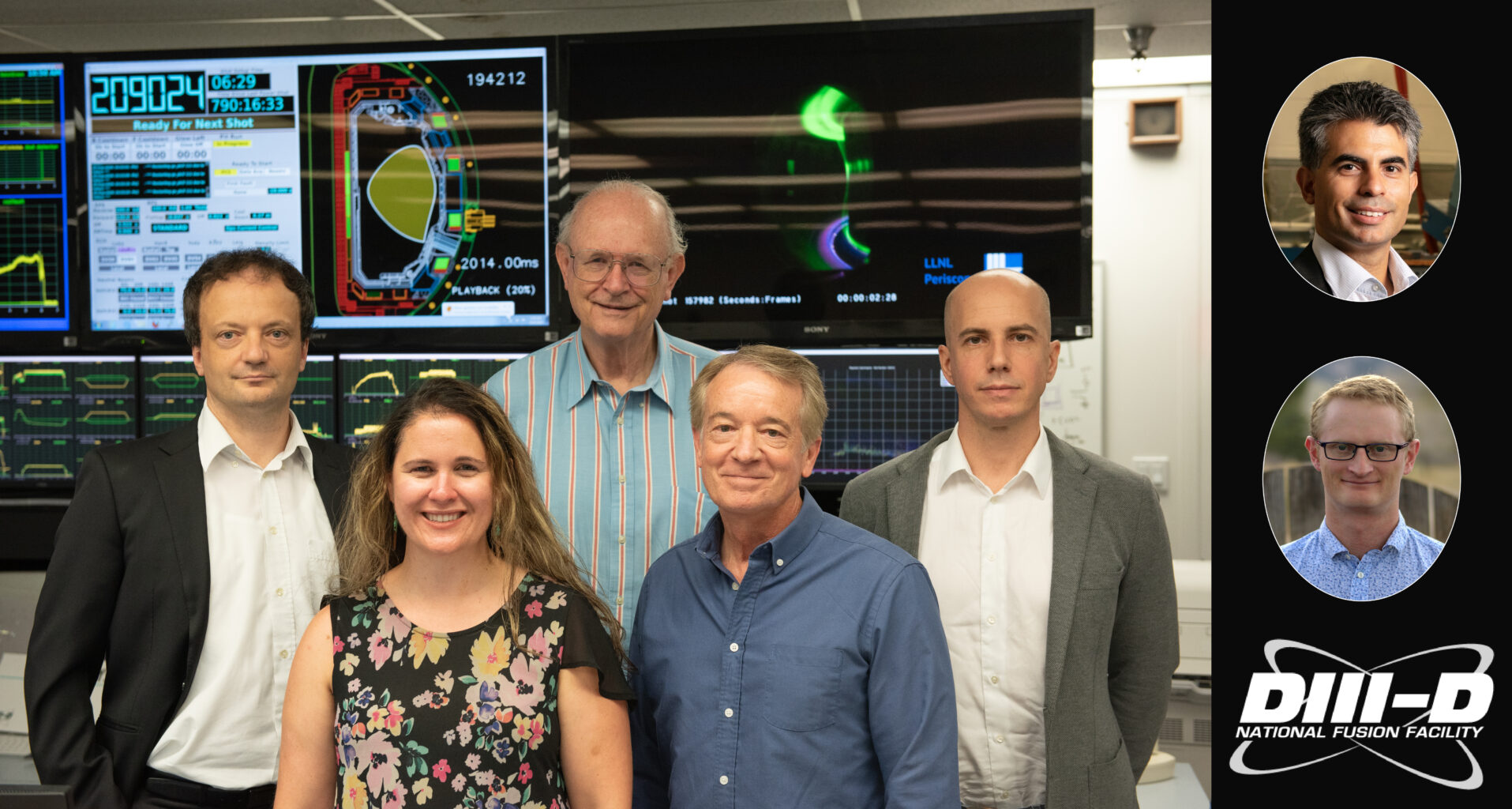
SAN DIEGO (30 September 2026) – The race toward commercial fusion energy requires scientists and engineers to continue rapidly solving key challenges and optimizing solutions for fusion science and technology. The ultimate goal is the development of a device that operates continuously with high performance and stability. A multi-institutional team from the U.S. Department of Energy’s DIII-D National Fusion Facility recently won the John Dawson Award for Excellence in Plasma Physics Research from the American Physical Society for substantially advancing the negative triangularity approach for fusion.
Development of Negative Triangularity at DIII-D
Tokamaks, donut-shaped devices that contain 100,000,000oC plasmas with magnetic fields to drive fusion reactions, are one of the leading designs for commercial fusion pilot plants (FPPs). Most development of operational approaches for tokamaks has focused on optimizing operation in positive triangularity, a D-shaped plasma with the curve facing the outer edge of the device. Positive triangularity plasmas can achieve high confinement, an important feature for power generation; however, these plasmas have notable challenges related to power handling that have yet to be solved for commercial power generation. Operation with lower confinement improves heat flux and power handling issues, with the trade-off of lower performance that would ultimately mean less power output for electricity generation.
An alternative solution is to move away from the positive triangularity shape altogether, operating the plasma in a reverse-D shape called negative triangularity (NT). Building on foundational work performed at TCV, Max Austin, Research Scientist at University of Texas at Austin, and Alessandro Marinoni, Assistant Professor at University of California San Diego, led initial NT experiments at DIII-D. They showed high performance without the development of instabilities that cause large releases of particles and heat (known as edge-localized modes, ELMs). These initial experiments motivated a dedicated campaign to fully explore NT, developing strongly shaped diverted plasmas under FPP-relevant conditions.
“The high degree of flexibility at DIII-D – not only in our ability to adjust our research program to meet priority needs but also in the ability to change physical and operational features of our tokamak – is essential for supporting innovation in fusion science and technology. We can make changes and comprehensively measure their effects on commercially relevant fusion plasmas, accelerating progress toward identifying the best solutions for fusion energy,” said Richard Buttery, DIII-D Director. “In the case of negative triangularity, we could rapidly implement a change to the device to support a focused campaign that dramatically advanced our understanding of this unique approach.”
Negative Triangularity Campaign
Beginning in 2022, the team exploited the flexibility of DIII-D as a research platform to embark on a dedicated diverted NT campaign. Filippo Scotti, Research Scientist at Lawrence Livermore National Laboratory, worked with the General Atomics Engineering team for DIII-D to replace the standard tile armor in the lower divertor with specialized tiles designed for NT operation. Although DIII-D was designed for operation in positive triangularity, dedicated efforts led by Al Hyatt, Chief Physics Operator on the DIII-D Operations team at General Atomics, and supported by Oak Nelson, Associate Research Scientist at Columbia University’s School of Engineering and Applied Science, developed an approach to operate the tokamak in NT scenarios with the new armor.
The dedicated NT campaign was led by Carlos Paz-Soldan, Associate Professor of Applied Physics at Columbia University’s School of Engineering and Applied Science, and Kathreen Thome, Staff Scientist at General Atomics, with Austin serving as the campaign deputy. They spent weeks exploring diverted plasmas with strong NT shaping to validate this approach for tokamak operation. The plasmas produced during this campaign consistently exhibited high confinement and strong stability over a vast operational space.
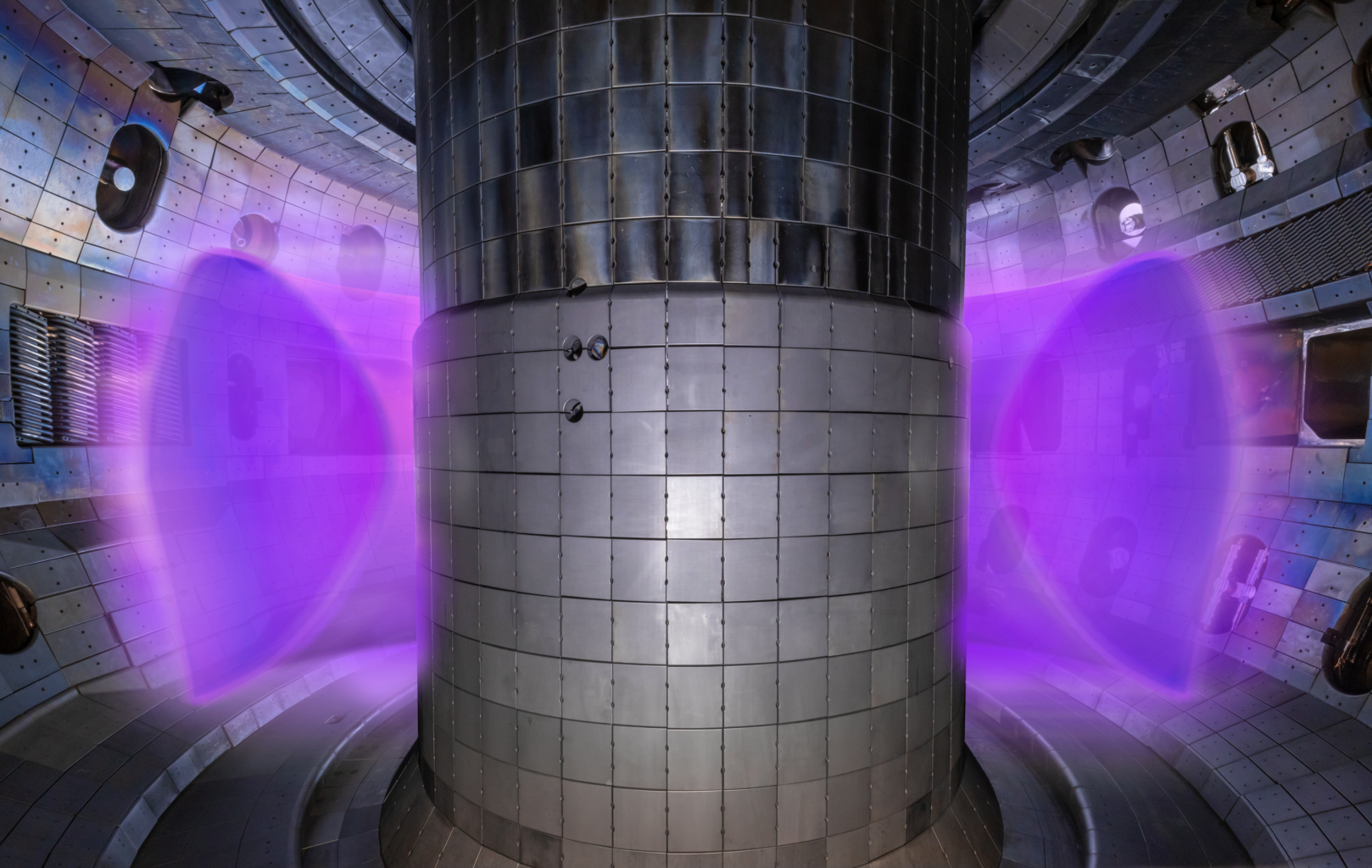
“The campaign was incredibly exciting – we produced high-performance plasmas on DIII-D for weeks without seeing a single ELM. No one had ever accomplished something comparable before,” said Thome. “This campaign was the most fun, and maybe also the most stress, I’ve ever experienced in the control room. NT is a potentially revolutionary way to design and operate a tokamak for fusion energy, and helping lead this effort to demonstrate the commercial potential of this unique scenario was an extraordinary moment in my career.”
Key experimental contributions were also made by Scotti, Nelson, and Marinoni. Scotti conducted the first experiments evaluating heat exhaust, achieving detached divertor conditions during NT operation of a tokamak for the first time and motivating the design of a closed pumped NT divertor, an effort led by Scotti, for installation on DIII-D in the near future. Building on Marinoni’s earlier work identifying a mechanism associated with ELM inhibition in NT plasmas, Nelson confirmed its occurrence across a much broader range of conditions. Marinoni also explored how the observed NT confinement would extrapolate to an FPP. The work led by these scientists, showing simultaneous achievement of high performance in the plasma core with mitigated heat flux at the divertor, demonstrates that NT operation can achieve key features required for future FPPs.
“The US Department of Energy’s Fusion Science and Technology Roadmap calls for advancing confinement approaches that combine high performance, stability, and effective power exhaust. DIII-D’s negative triangularity research is making important progress on that challenge, while growing engagement with the private sector is helping move promising concepts toward commercial fusion,” said Matthew Lanctot, Acting Director, Fusion Energy Research Division, DOE Office of Science.
Moving Negative Triangularity Forward
The NT research performed at DIII-D has established momentum for the development of NT-based machines around the world. Through 2026, DIII-D team members continued to advance the NT approach, optimizing plasma shape and further understanding NT confinement and stability properties in dedicated experiments. In the near future, DIII-D will be installing an NT-optimized divertor through a public-private partnership with Kyoto Fusioneering to advance this operational approach for commercialization. The innovative research performed at DIII-D today continues to develop the solutions needed to mature fusion into the energy source of the future.
Further Reading
Research results for NT work at DIII-D have been published in peer-reviewed journals and presented at international conferences over the last several years. Many papers can be found in a special NT issue of Plasma Physics and Controlled Fusion, with a more extensive list of publications available here.
NT work at DIII-D has also been detailed in multiple Science Highlights published by the Department of Energy Office of Science (Nelson Science Highlight on ELM-free operation, Scotti and Paz-Soldan Science Highlight on core performance and power handling). A General Atomics press release describes the NT armor and campaign goals, and the DIII-D website and an APS-DPP press release provide more general information on the dedicated campaign.
The DIII-D team also wishes to acknowledge the seminal contributions TCV has made to advancing the negative triangularity concept for tokamaks. More information on their extensive work in NT research can be found on their website.