
Negative Triangularity at DIII-D
New Public-Private Partnership
US Department of Energy’s DIII-D National Fusion Facility and Private Fusion Company Kyoto Fusioneering Announce Collaboration on New Negative Triangularity Capability for DIII-D Tokamak
In a new public-private partnership, Kyoto Fusioneering and the DIII-D National Fusion Facility are pursuing negative triangularity for commercial fusion.
SAN DIEGO (5 October 2026) – The DIII-D National Fusion Facility, a U.S. Department of Energy (DOE) user facility advancing fusion science and technology, is pleased to announce the development of new capabilities to support commercialization research. The effort is a collaboration with Kyoto Fusioneering, a global leader in fusion technology and integrated systems, building on the partnership with DOE announced in January. This public-private partnership will move from design through to operation and experimentation with a new power exhaust system in the DIII-D tokamak. The enhancement utilizes DIII-D’s function as a flexible fusion testbed to enable scientists and engineers to develop a new capability in pursuit of negative triangularity for commercial fusion applications. This enhancement and associated research program directly advance interconnected challenge areas identified in DOE’s Fusion Science and Technology Roadmap.
The Potential of Negative Triangularity
The promise of fusion, the process that powers the stars, is a future with abundant power being aggressively developed in the public and private sectors, with many different approaches being actively explored and optimized. Negative triangularity, or plasma in a reverse “D” shape, is a potentially transformative operational approach for tokamaks, donut-shaped fusion devices that contain plasma with magnetic fields. This approach has key benefits for commercial operation and is being pursued by private companies designing fusion pilot plants. Notably, negative triangularity exhibits high performance while avoiding damaging heat burst instabilities. This mode of operation also dissipates the high heat loads emerging from fusion through benign radiative processes, easing engineering requirements for the device wall. However, this approach has yet to be evaluated with a commercially relevant divertor to manage the unique plasma heat and particle exhaust features of this approach, reflecting the need being addressed by this industry-driven effort.
“Our need to understand negative triangularity in a commercially relevant device setup led to the collaboration between DIII-D and Kyoto Fusioneering,” said Suk-Ho Hong, DIII-D Fusion Technology Outreach Coordinator. “This new capability will enable us to fully evaluate this promising approach together, continuing DIII-D’s legacy of providing a rapid, cost-effective platform to test cutting-edge technologies and approaches for fusion energy.”
Negative Triangularity Divertor
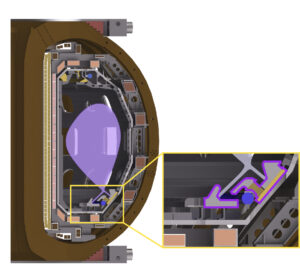
Engineers and scientists from the organizations are leading a collaborative group from the larger DIII-D program to design, manufacture, and install a negative triangularity divertor. Subsequent operation and experimentation will demonstrate a reactor-relevant core-edge solution for fusion energy. Through this industry-driven initiative, Kyoto Fusioneering will collaborate with the DIII-D team to realize the negative triangularity divertor, which can be exploited to advance their commercial fusion technology through experiments. Notably, as data are shared freely within the program and capabilities are available to all members of the DIII-D program, this work is expected to have broader benefits that support work by additional fusion pilot plant developers.
This plan will leverage the engineering and manufacturing expertise of Kyoto Fusioneering in conjunction with the engineering and operations expertise of DIII-D to produce the needed data and operational experience on the ambitious timescale needed for commercial relevance. The two organizations will collaborate on the design process, with Kyoto Fusioneering then manufacturing and supplying all tiles needed to build the negative triangularity divertor. After installation, Kyoto Fusioneering and their partners at Columbia University will work alongside the broader DIII-D program to use this divertor to tackle key remaining issues, including core-edge integration, power exhaust, diagnostic composition and performance, and stress to plasma-facing components.
“High neutron loads and heat fluxes are among the most critical challenges to the viability of fusion power plants. By leveraging Kyoto Fusioneering’s engineering and manufacturing capabilities to develop and test novel divertor concepts at DIII-D, we aim to contribute to the early realization of commercial fusion power,” said Bibake Uppal, President of Kyoto Fusioneering America.
With this new capability, DIII-D continues to fulfill its mission to develop and refine solutions for clear needs in fusion science and technology with its expert collaborative team. This public-private partnership exemplifies the rapid progress that can be achieved through participation in the DIII-D program, continuing its mission to derisk commercial decisions and support essential scientific and technological advances for fusion energy.
About the DIII-D National Fusion Facility. DIII-D is a highly flexible, comprehensively diagnosed magnetic fusion research facility and has been the site of numerous pioneering contributions to fusion energy science. As a fusion testbed enabling critical science and technology advances, DIII-D continues the drive toward practical fusion energy with critical research conducted in collaboration by nearly 1000 scientists representing over 125 institutions worldwide. Research at DIII-D, a U.S. Department of Energy Office of Science User Facility, is open to all interested parties. For more information, visit d3dfusion.org.
Research Application Alignment to the DOE Fusion Science and Technology Roadmap
The research program associated with this new negative triangularity capability will broadly enable advances in this fusion approach, as this enhancement will be available to the entire DIII-D team. This work directly advances topics in the DOE Fusion Science and Technology Roadmap across multiple challenge areas. For Advancing Confinement Concepts, research will evaluate the confinement, stability, and transient control characteristics of negative triangularity. Work performed with this new enhancement will explore whether operation in integrated scenarios holds promise for commercialization, demonstrating a fusion pilot plant-relevant core-exhaust operating scenario and improving design-grade predictive capabilities. For Plasma-Facing Components and Plasma-Materials Interactions, research will advance our understanding of power and particle control. Data will also be used to validate tools and workflows for divertor design and optimization and to demonstrate divertor designs that are capable of detached operation with high particle exhaust and core performance. For Fusion Plant Engineering & System Integration, investigations will produce uncertainty-quantified data for an end-to-end integrated workflow relevant for whole-plant modeling.
Further Reading
The DIII-D Negative Triangularity Team recently won the 2026 John Dawson Award for Excellence in Plasma Physics Research, awarded by the American Physical Society. Read more about the team’s work and the award citation here.
Research results for NT work at DIII-D have been published in peer-reviewed journals and presented at international conferences over the last several years. Many papers can be found in a special NT issue of Plasma Physics and Controlled Fusion, with a more extensive list of publications available here.
NT work at DIII-D has also been detailed in multiple Science Highlights published by the Department of Energy Office of Science (Nelson Science Highlight on ELM-free operation, Scotti and Paz-Soldan Science Highlight on core performance and power handling). A General Atomics press release describes the NT armor and campaign goals, and the DIII-D website and an APS-DPP press release provide more general information on the dedicated campaign.